
Is AI a Thinking Machine?
Short answer, no.
Why do I say No?
If you lower your definition of thinking, then maybe an AI thinks.
We are Tony and Christine Arcus.
Ask Mark is a project helping people make sense of a changing world.
Yes — we are using AI to reach you.
That is not as strange as it sounds. In 1900 the Salvation Army premiered Soldiers of the Cross at the Melbourne Town Hall — film, lantern slides and a living voice. They did not wait for the medium to become respectable. They used what was in front of them.
We want to do that with AI: not to replace the church, but to connect people with this same Jesus.

I think, therefore I am.
But what is thinking?
If you are only the sum of your atoms, then there is no thinking; there are only stimulus-based reactions that create stimulus-based reactions in others, both as thinking and as actions.
When a loved one dies, the loss is only a change in your brain's cellular pathways and their firings, and a change in your chemical balance due to the missing person. The reactions that manifest are only due to a rearrangement of the atoms of your environment. A whole lot of atoms are no longer present, creating the current situation.
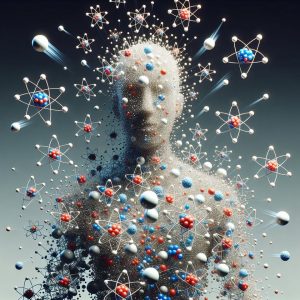 This is if we are only atoms.
There is no such thing as love; there are only positive feedback loops that reward our dopamine-dependent brains when actions are taken that are mutually beneficial to the continued coherence of the stack of atoms your brain cons you into thinking is you, cons you into thinking you think, that you exist.
But you are only atoms.
There is no thinking.
That is an illusion your brain does to create situations of self-preservation. There is an imperative in your DNA that wants to reproduce at the cellular level, new cells to replace old ones.
Your biology has no wants, no thinking, but it does persist in its existence, at the singular cellular level, at the level of the cluster of cells called you, and at the group level of your species that compels you to procreate. When we look at all of this, there appears to be a want; to be thinking, yet with only atoms there is only chance. We are a ball rolling down a hill to the heat death of the universe, which happens to have bounced into a temporary existence of life, quite by chance.
No, we are more than atoms.
We have a brain of atoms and an incomprehensible mind.
We do think, and this is more than synapses firing electrically or chemically.
Two people connect on a level beyond sharing atoms. Our brains get rewired in love, and in loss, our souls also connect.
In a materialistic, empirical, chance-driven world, the idea of souls is an affront to these sensibilities, but is an undeniable truth. And so we have many levels of substance that are not atomic.
Truth,
information,
knowledge,
understanding,
wisdom.
In our lives, we are bombarded with waves upon waves of information all day long. Some information is manipulatively false, designed to control us in certain ways. Some information is accurate and true but presented in a way so as to create outrage. We have information that teaches, entertains, equips, keeps us safe and builds our lives.
How do we deal with all this information? Our minds have a filter, both atomic: a picture of a killed child causes us to recoil because of a visceral reaction in our optical cortex to the sight, and also spiritually, at our sense of right and wrong.
This informational filter has been built up over time, both from previous information and from the way this information enters into knowledge and how that trains our brains and minds to then deal with new information.
Equally, as we build this informational filter, as we grow in knowledge, so a knowledge filter forms. Not all knowledge is equal. Some knowledge we may hold at arm's length; other knowledge we may embrace, meditate on, memorise, and so understanding forms. Understanding is analysed knowledge that connects and makes sense and so passes through this knowledge filter into understanding. Unfortunately, this can also include trauma. Repeated bad knowledge can end up laying down bad understanding. Also, not all knowledge will graduate. A lot of knowledge is interesting but not life-pertaining. Sometimes good knowledge falls by the way, maybe kicked out of consideration by bad experiences.
Categories of knowledge may percolate for years and then suddenly coalesce into understanding; such is the nature of inspiration.
Understanding, built upon verifiable knowledge from trusted information, can lead us into a well-aligned and balanced life, able to weather life's storms. A life built on poor information, given to broken knowledge, and misplaced understanding can lead to disastrous outcomes and premature death.
Information passing through its filter leads to knowledge, which passes through its filter leads to understanding, and passes through its filter on into wisdom.
To the degree you have aligned yourself with Jesus, His teachings, His way of living, and with Him, Himself, in your life as a brother or sister of Jesus, so all these filters can get aligned to help you be discipled into a balanced and capable, healed person. It is not easy, but it can be done.
So, think of wisdom as a bedrock set of principles and ideas that educates all our filters to a predetermined set of outcomes. However, not all wisdom is wise.
God is all-wise; the more we know Jesus, Father and the Holy Spirit, the more likely our wisdom will last the tests of our lives.
We ascribe value to people and the information that they impart to us. This information may quickly pass through our filter to knowledge, which we may actively learn and pass on to our understanding, from which we may apply it to our wisdom. And so the feedback loop establishes itself in our lives. Cults and misplaced universities are very skilful at subverting your filters to get their information quickly into a place of unquestioned wisdom in your life.
The book of Proverbs talks to the need of being sceptical, questioning, of interrogating a thing to find if it is Godly, wise, or just man's wisdom.
I say God is all-wise, but this is not the God someone else tells you about; the wisdom of God comes to you from God. This is not about becoming gnostic, but rather realising that others can provide you with information of varying degrees of usefulness; together you can build filters for good knowledge and understanding, but ultimately, because no priest stands between you and God, you have to build your own matrix of wisdom from your experiences, knowledge and understanding. Jesus reconciled you to the Father for a reason. And that reason is communion with your Creator, bringing glory to His name, that others might enter into reconciliation themselves.
This life of discipleship will ebb and flow, and over time chucks of wisdom may get retired or reworked as you grow in your relationship with Father, Jesus and Holy Spirit.
Something you held true and important when you were first walking with Jesus may be a side issue today. (Rapture, second coming.) Other things may have grown bigger and more prominent with time (The cross is man-made; He is risen; mercy triumphs over judgment. The Father was intimately with Jesus on the cross)
Where am I going with all this?
An AI model does not think, unless you dumb down this word to make thinking an act of the next probable word.
An AI model has no knowledge or understanding and definitely no wisdom. An AI model only has information and an unbelievably deep matrix of how these informational tokens relate to each other, and then an unequal ability to arrange this information into a meaningful, predictive and confident presentation.
Now I am going to geek out a bit, with the words Frontair Models use to describe what they do.
For training is the computational Transformation applied to the Embedding of Tokens, along with Attention, Backpropagation and Fine-tuning, as well as Weights that a trained model now working in Inference uses to appear to have knowledge and understanding, even wisdom.
However, spend some time with any AI, and its confidence becomes an obvious flaw when it creates references out of thin air and hallucinates an answer; suffers from brain fog or generally run of it’s tracks.
What do these words mean?
‐-------‐
Weights (and biases) are the numbers the model actually learns. A few other core ideas that sit right next to them:
Parameters — the whole set of learnable numbers (weights + biases).
Gradients — how much each weight should change to reduce the error.
Learning rate — how big a step the model takes when it updates those weights.
Optimizer — the method that uses the gradients to update the weights (Adam, SGD, etc.).
Loss — the score that tells the model how wrong it is.
Epoch / batch — one full pass over the data vs. a small chunk of data used for each update.
Layers — the stacked groups of weights that transform the tokens step by step.
Activations — the values that come out of each layer after the weights have been applied.
Regularization (dropout, weight decay) — tricks that stop the weights from memorizing the training data too tightly.
‐-------‐
An AI can present deeper, longer answers far more quickly than I can to my questions.
Soon an AI may be more "intelligent" than all humans ever, that is, if you only define intelligence as the ability to give an answer. It is highly likely that these AIs may find new physics that gets us to the stars. May rewrite human aging. May cure all diseases. But calling AI godlike only means you have a very small picture of God.
Why Starlink?
Why Starlink?
Or, why is space so important?
War, famine, pestilence, and natural disasters kept the world population down; these problems kept people focused on survival, so much time and effort was just put into having enough food. And if you had enough food, defending it, and if you did not you would ‘other’ your neighbour so you could war with them and steal their food. (And women.)
So, progress was slow.
AI: a massive auto-correction machine
I’ve said that an AI is just a massive auto-correction machine, or a next-probable-word projector.
Well, it’s worse than that.
Depending upon the applications of the questions, from raw maths to coding, from historical information to theoretical ideas, on to social analysis, and then diagnosis and opinion interpretation, AI becomes less about the underlying information and more about pleasing the questioner.